Solutions
You are not being replaced. You are being handed the first draft.
Most of an analyst's week is not analysis. It is reading a hundred pages, retyping what was agreed, renumbering a document because a section moved, and rebuilding the traceability matrix after a restructure. That is the part this takes away.
What changes on a Monday morning
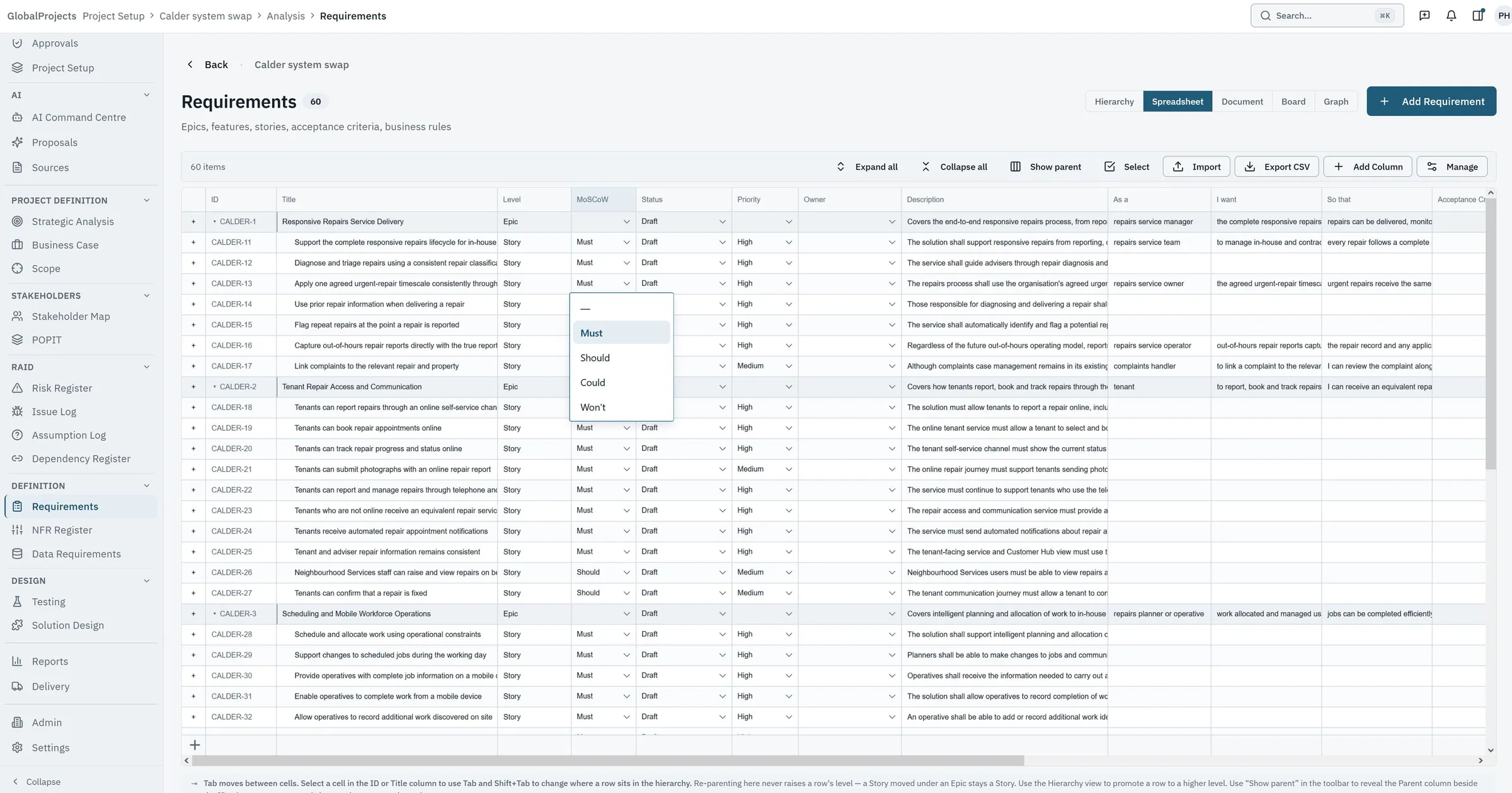
It behaves like the spreadsheet
Frozen identifier column, keyboard navigation, copy and paste, collapsible levels, your own columns. It was built to be judged against the spreadsheet you already have open, because that is the real competitor.
-
The reading is already done
The discovery pack, the old specification and last week's transcripts have been read and drafted into proposed scope, requirements, stakeholders and risks. You start the week reviewing rather than starting.
-
You are still the one who decides
Every proposal is a row you accept, edit or reject, with the evidence beside it. Nothing enters the requirements set without you. The skill being used is your judgement, not your typing speed.
-
Your existing list comes with you
Paste a range in from a spreadsheet you already maintain, mapped by column. You do not start from an empty project.
-
The document writes itself
The specification is generated from the record, in the same shape every time. No more copying out of the grid and fixing the formatting the night before a review.
-
The matrix stops decaying
Links are made as you work and maintained when the structure moves, so traceability stops being the thing you rebuild and start dreading.
On being asked to use another tool
Analysts have been handed a lot of tools. Most of them added a place to retype what was already written somewhere else, and quietly measured how diligently that retyping was done. The spreadsheet survived because it was faster than all of them and never argued.
The only honest way to replace it is to be better at the thing it is good at — dense, fast, flexible editing — before asking for anything else. That is why the grid came first and why it is held to that bar permanently. If it ever feels worse than the spreadsheet, the rest does not matter.
Judge it on your own requirements
Bring a page of a real requirements list. Fifteen minutes will tell you more than any feature list, and you are the person whose verdict decides this.