Business analysis, structured
Replace the manual analysis between an idea and a signed-off requirements set.
Your business analysts read the documents, chase the stakeholders, write the requirements in Word, track them in Excel, and rebuild the traceability by hand every time something moves. GlobalProjects keeps all of it as one structured record — and puts an AI to the reading, while a person stays in charge of every line that lands.
It fits the way your team already works
- Word — the requirements document exports as one your sponsor will actually read
- Excel — paste a range straight into the grid, mapped by column
- PDF — read as a source, text and all, without retyping it
- Notes and transcripts — plain text in, structured requirements out
Three reasons this one gets used
Most analysis tools fail for the same reason: they ask a business analyst to give up the spreadsheet, trust the machine, and hope nobody asks where a requirement came from. This one is built the other way round.
-
The spreadsheet your BAs already know
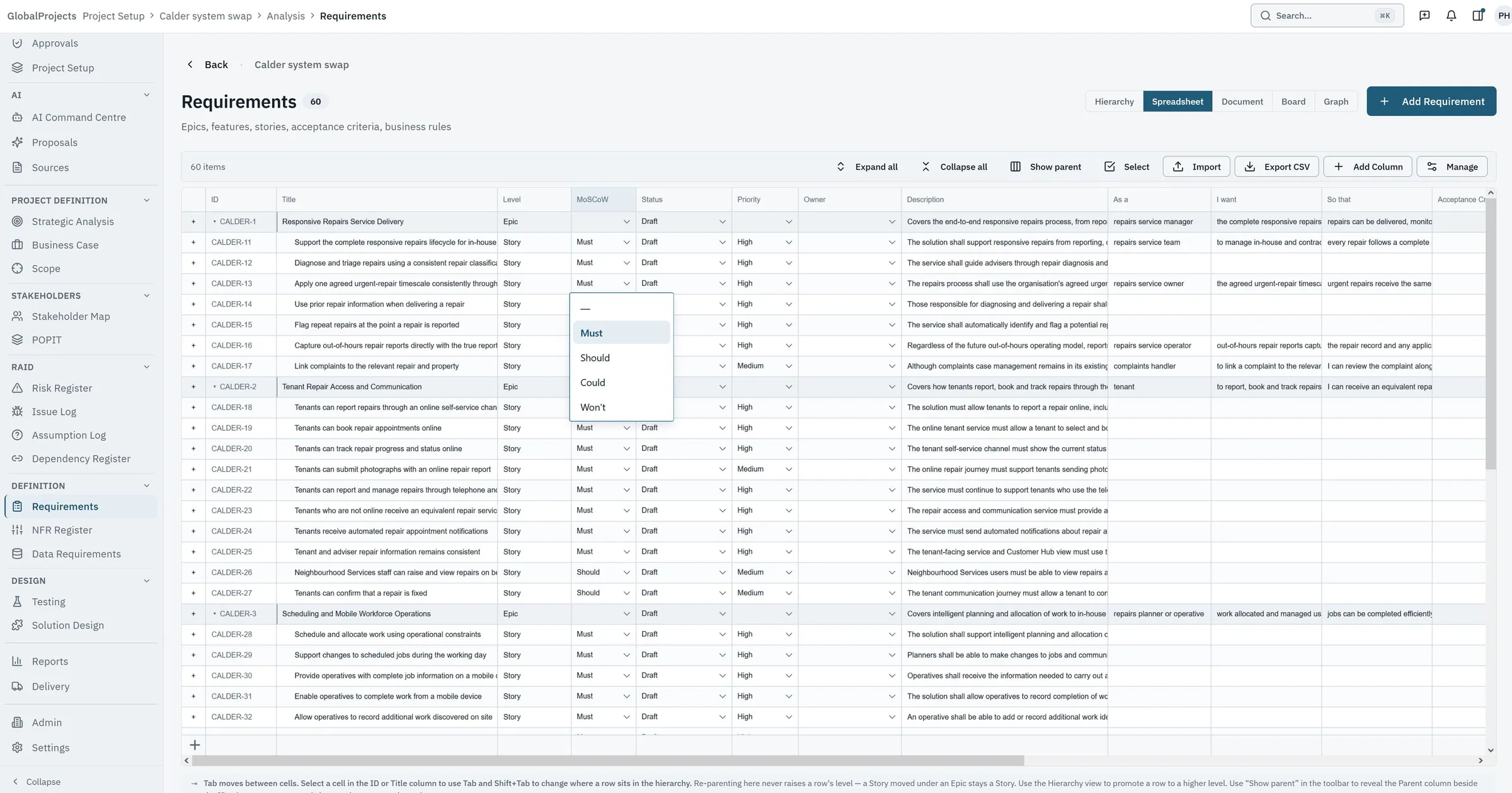
The main working surface is a dense, fast grid — frozen ID column, keyboard navigation, copy and paste, columns your team adds itself, and hierarchy levels that collapse like an outline. It is held to the standard of the spreadsheet it replaces, because a tool people do not open changes nothing.
-
AI that proposes and never commits
The AI reads your documents, transcripts and notes and proposes scope, requirements, stakeholders, risks and open questions. Every proposal is shown as a row with the evidence behind it, and a named person accepts or rejects it. Nothing an AI produces reaches your record on its own. This is a rule in the architecture, not a setting.
-
Traceability from source document to requirement
Every requirement can be traced back to the document, transcript or decision it came from, and across to the scope, risks and assumptions it touches. The links are maintained as the structure moves, so a reorganisation does not quietly cost you the audit trail.
How it works
Five steps from a folder of source material to a requirements document your sponsor can review.
Bring your sources
Upload the discovery pack, the meeting notes, the old specification, the transcripts. Each one is stored, readable in place, and fingerprinted so you can tell if it changes.
Run a pass
A pass reads the sources you choose and drafts one kind of thing: scope lines, requirements, stakeholders, risks, assumptions, open questions.
Review every row
Proposals arrive in a queue with their evidence. Your analyst accepts, edits or rejects each one. Only accepted rows become real items.
Work the record
The accepted items are one structured record seen as a hierarchy, a spreadsheet or a document — never three copies to keep in step.
Issue the document
Export the requirements document to Word for the review and sign-off process you already run, generated from the live record rather than maintained beside it.
Who this is for
Heads of change
You are carrying more demand than analyst capacity, and the honest constraint is how fast a person can read, structure and write. This moves that constraint without lowering the standard of what gets signed.
PMO and delivery leads
You need to know what is in scope, who agreed it, what it depends on and what changed since last month — as data you can query, not as a document someone has to open and read.
Business analysts
You keep the judgement and lose the typing. The first draft is already on the page with its evidence attached; your work is deciding whether it is right.
See it against a project of your own
Bring a real discovery pack to a call and we will run it through in front of you — sources in, proposals reviewed, requirements out — so you are judging the output, not a demonstration script.