Solutions
The AI may run itself. It may never write itself.
In a regulated organisation the first question about any AI feature is not what it can do — it is what it can do without a person, and whether you can show where that limit is enforced. Here the limit is in the write path: there is no route by which a model's output becomes a requirement without a named human accepting it.
What you can put in front of a risk committee
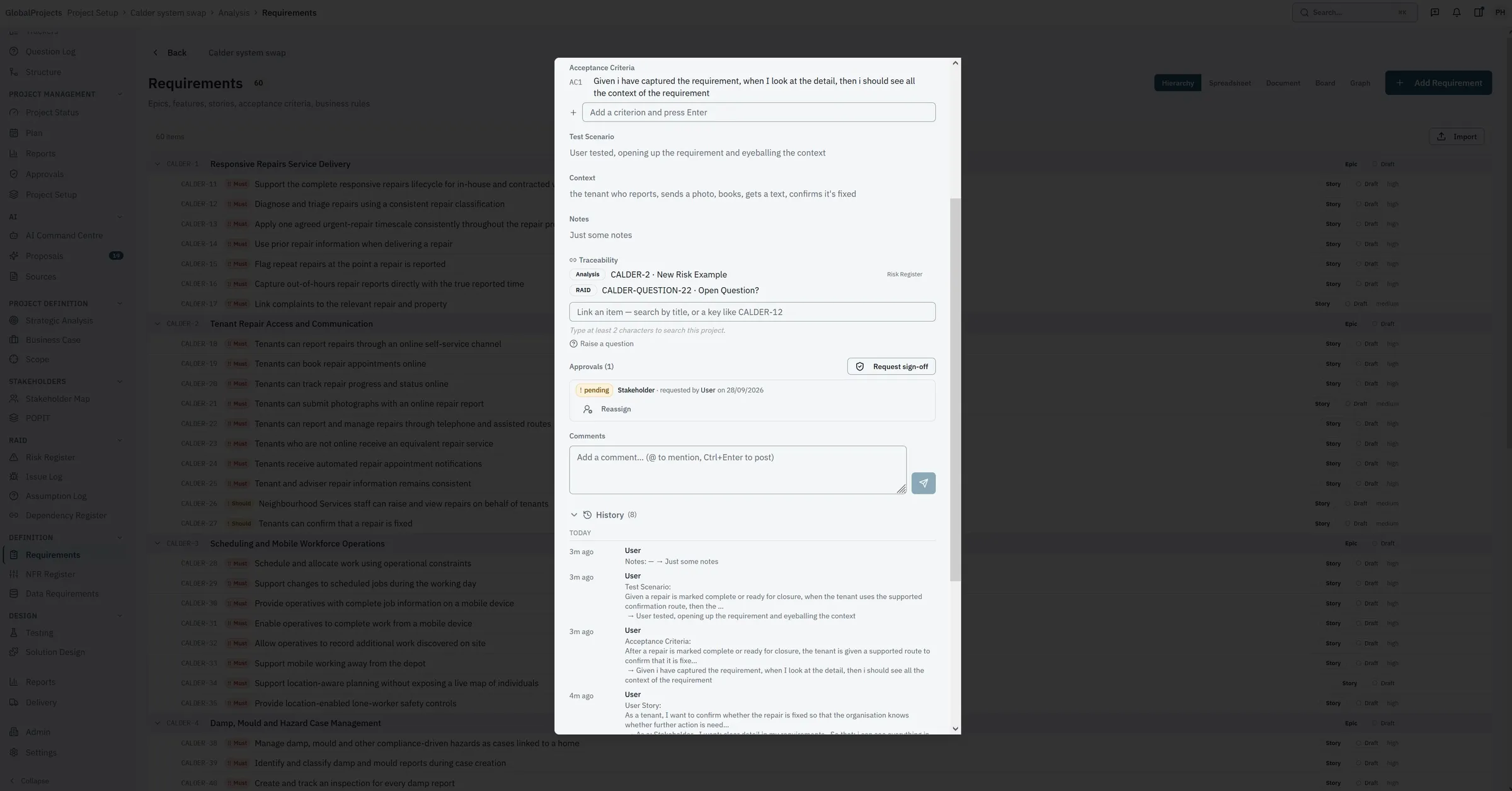
The history is part of the record
Before and after, who and when, on every change — kept with the item rather than in a log that has to be requested and correlated.
-
Review before commit, structurally
Anything produced in bulk — by an AI pass or by a paste from a spreadsheet — is shown row by row before it is created, and there is no instant-commit path to reach for. It is a property of how writing works here, not a preference that could be changed by an administrator in a hurry.
-
A person's name on every accepted line
Because nothing writes itself, every item that started as a proposal has an accepting user recorded against it. There is no scenario in which the honest answer to "who approved this" is "the system".
-
Your data in its own database
Each customer has a separate database and a separate access team. Isolation is a property of where the data lives, not a filter applied to a shared table and trusted to always be correct.
-
A deployment of your own, if you need one
Where your policy requires it, a customer can have a complete independent deployment — its own server, its own database, its own hostname — rather than a partition of somebody else's.
-
States your method defines, enforced
Configurable statuses and controlled transitions, and a transition can require a specific capability, so the lifecycle your framework mandates is the one the workspace actually enforces.
The questions that decide it
- Can the AI change a requirement without a human?
- No. A pass can be triggered automatically, but everything it produces is a proposal that waits for a person. Running and writing are separate, and only running can be automated. If that were ever to change it would require a superseding architectural decision, not a configuration change.
- Is our content used to train an AI model?
- The providers' published terms for their paid interfaces say it is not. We link those terms on the security page with the date we last read them. Where your organisation uses its own provider account, that contract is directly between you and the provider.
- Can we keep our data in a deployment of our own?
- Yes. A dedicated deployment is available, and hosting is arranged to suit the requirement rather than fixed by us.
- How do we evidence who changed an agreed requirement?
- Every change is recorded with its before and after state, the person and the time, and kept against the item itself. Access to make the change is decided by roles and capabilities checked on the server before the write happens.
Send us the assessment questions
If you have a supplier assessment or an AI governance questionnaire, send it before the call. It is a faster way to find out whether this fits than any demonstration.