Solutions
The constraint is analyst capacity. This moves it.
Demand does not arrive at the rate your analysts can absorb it, so projects queue behind the analysis rather than behind the build. Adding people is slow and expensive; lowering the standard of what gets signed off is how delivery problems start. The third option is to take the reading and the retyping out of the job.
What you get that a document cannot give you
Reports without a reporting week
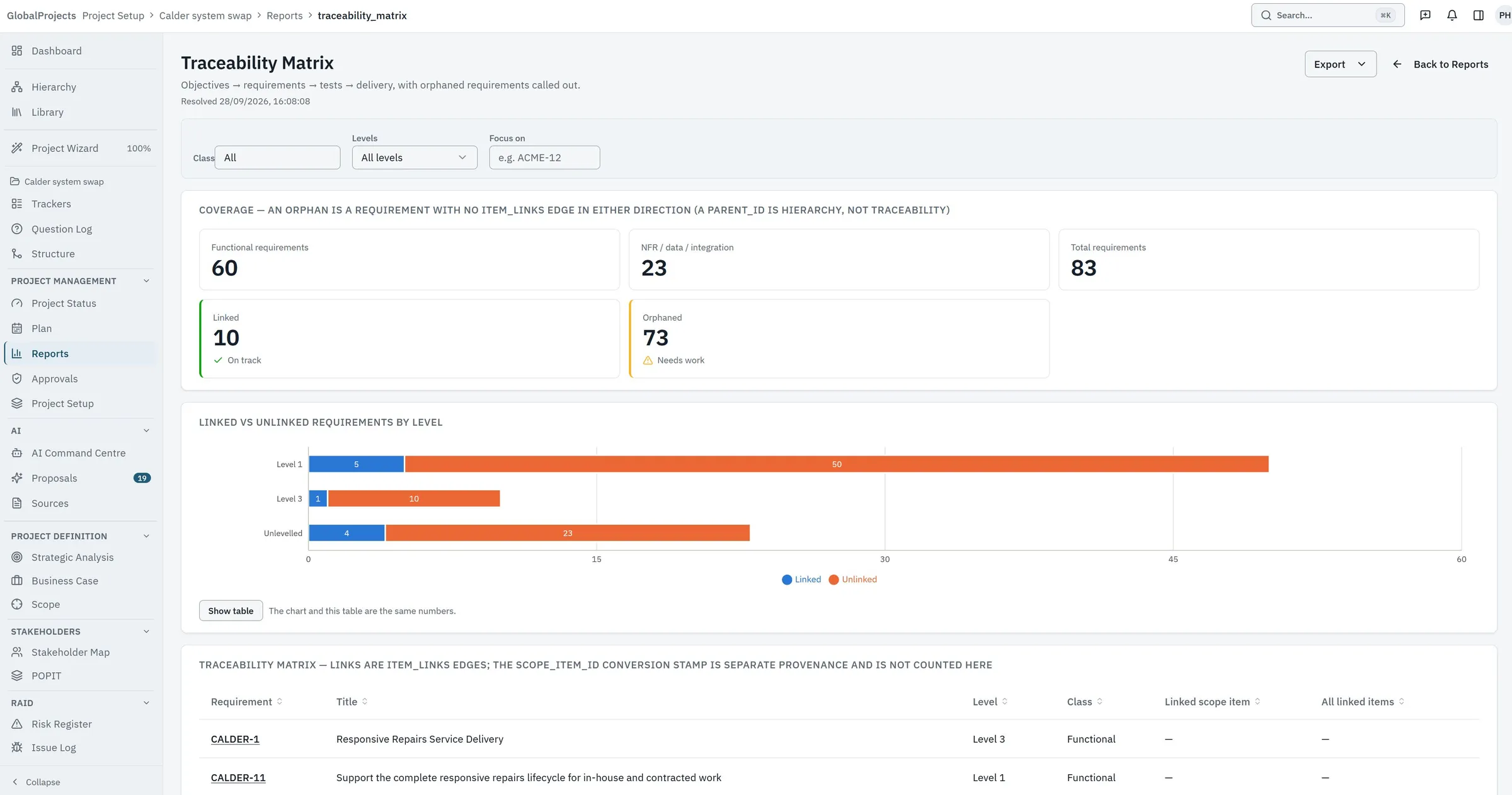
Generated from the live record and read in place. The effort that currently goes into assembling a pack goes into deciding what the pack says.
-
Scope as data, not as prose
What is in scope, at what level, in what state, owned by whom — as a record you can filter and count, rather than a document somebody has to read and summarise for you.
-
One version, by construction
The hierarchy, the grid and the specification are three renderings of one record. There is no circulated copy to go stale, and no reconciliation step before a board meeting.
-
Registers attached to the work
Risks, issues, assumptions, dependencies and decisions are linked to the requirements they affect, so a risk review can start from what it actually threatens.
-
Change you can evidence
Every change is recorded with what it was, what it became, who did it and when — so "what changed since we agreed this" is a question with an answer rather than an argument.
-
A consistent standard across projects
The fields your method requires are defined once and appear on every project that uses them. Quality stops depending on which analyst was free that month.
On tools nobody adopted
Most PMO leads have bought at least one workspace that was correct in every respect except that the people it was for kept using the spreadsheet. The failure is almost never in the feature list. It is that the daily working surface was slower than what it replaced, so it lost every time somebody was in a hurry.
That is why the grid was the first thing built here and why it is held to the standard of Excel rather than to the standard of other software. Adoption is the whole game; everything else is a feature that never gets used.
Put a real project through it
Pick a project that is queued behind analysis right now. Running its discovery pack through in front of you answers the capacity question directly.