Product
The AI proposes. A person decides. That order is not configurable.
Every tool in this market now claims AI. The question a regulated buyer actually has is narrower: what can it change without a human, and can you show me where that boundary is enforced? Here the answer is nothing, and the boundary is in the write path — not in a setting an administrator can move.
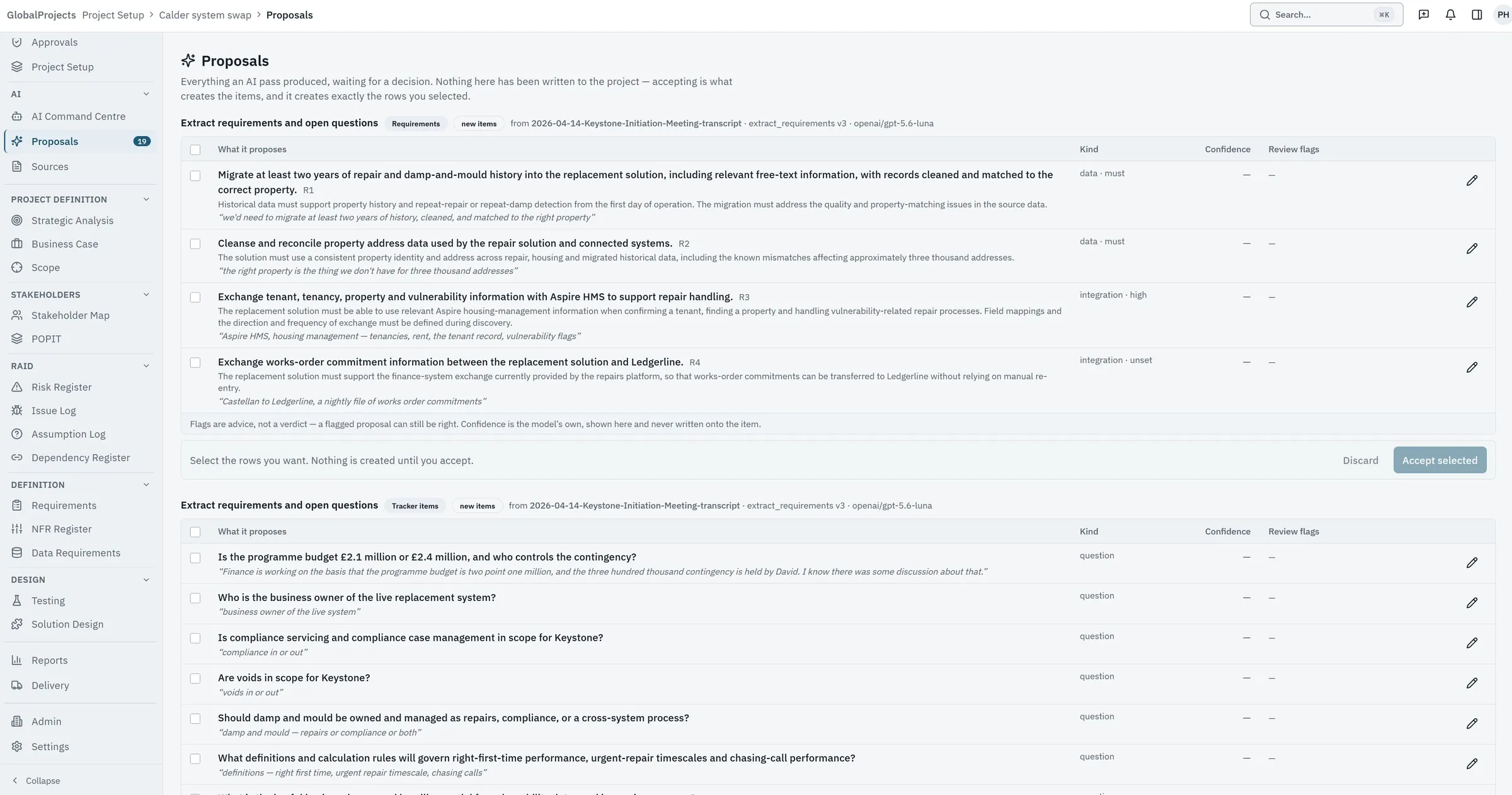
What a pass actually does
You choose the sources
Documents, transcripts and notes are uploaded to your workspace, readable in place and fingerprinted. You pick which ones a pass reads.
You choose the pass
Each pass drafts one kind of thing — scope lines, requirements, stakeholders, risks and assumptions, open questions — rather than producing an essay you then have to take apart.
It proposes, with evidence
Proposals arrive as rows, each carrying what in the source it was drawn from, so a reviewer can check the claim rather than judge the tone.
A person accepts or rejects
Row by row. Accept, edit, reject. There is no accept-all shortcut that skips the preview, and there is no path that writes without a person.
Accepted rows become real items
Only then. They enter the record as ordinary requirements, with their links and their history, and behave exactly like ones typed by hand.
What that buys you
-
The reading is done, the judgement is not
The expensive part of early analysis is reading a hundred pages and working out what is a requirement. That part is automated. Deciding whether a proposed requirement is right, complete and in scope stays with your analyst, which is where your organisation actually wants it.
-
A guided set-up, not an empty project
A new project walks through its own set-up — sources, scope, stakeholders, assumptions, requirements, open questions — so the first session produces a structured draft rather than a blank page and a decision about where to begin.
-
Open questions are an output, not a failure
Where the sources do not answer something, that becomes a recorded open question with the gap named — which is what a good analyst would have produced, and far more useful than a confident invention.
-
You choose the AI provider
The provider is configured for your organisation, and a company can use its own account so the relationship with that provider stays directly theirs.
-
One place to run and watch the AI
A single screen for the sources, the passes available, what is running now, what each run cost and what it produced — so the AI is something a lead can oversee rather than something that happens inside other people's screens.
The questions a risk committee asks
- Can we turn on fully automatic requirement generation?
- No. A pass can be set to run automatically when something happens, but what it produces is always a proposal waiting for a person. Running and writing are separate things here, and only the first can be automated.
- Is our content used to train anybody's model?
- The providers' own published terms say content sent through their paid interfaces is not used to train their models. We link those terms on the security page along with the date we last checked them, so you can verify it rather than take our word for it.
- What if the AI gets a requirement wrong?
- Then a reviewer rejects it and it never becomes an item. That is the ordinary case rather than an incident, which is the point of putting the review before the write instead of after it.
- Can we use it without the AI at all?
- Yes. The requirements workspace, the spreadsheet, the document view, the links and the reporting all work whether or not a pass has ever been run.
Watch it run on material you know
Bring a discovery pack you have already analysed by hand. Comparing its proposals against what your team concluded is a much better test than any demonstration we could design.